
Underground Ammunition Storage Sites

Introduction
The modern-day city has rapidly expanded, encroaching on factories, power stations, and other industrial zones. This includes military complexes for munitions production and the storage of final bulk ammunition. For safety measures, buildings that are occupied by personnel require what is known as an inhabited building distance from explosive storage sites. This distance is one of many that are collectively known as quantity distance. The sites that store ammunition takes many forms and vary based on the need for storage—the colloquial name for storage sites of ammunition in magazines. I have been told that this is because ammunition gets put into a weapons magazine.
The most obvious solution to this type of problem is to create remote storage areas that take up a large amount of acreage that is free from encroachment. Another solution is to go underground to reduce the amount of space used on land. This solution is one that has been worked on for half a century but has gained much interest in the last twenty from counties with a high population and a scarcity of land.
Underground Storage
Underground storage facilities consist of a single chamber or a series of connected natural caverns and excavated chambers. The storage sites may usually consist of one access tunnel for each chamber, but it may depend on the topographical and geological situations and safety aspects of the selected storage sites. While the design may be different and depends heavily on the intent of the usage, underground storage is essentially a storage facility that lies beneath the earth's surface. One reason is that blast waves do not damage buildings and kill people in the line of sight of the explosive waves. Another is the ability to conceal the facility from potential adversaries and do pinpoint targeting to cause damage to munitions stockpiles. With today's satellite imagery, facilities can easily be targeted, and storage capability can be calculated for maximum damage with simple math. While going underground for protection is not a new concept and has been employed since ancient times. Today, with underground subways and silo bunkers, using underground space for explosive storage is not a recent idea. Still, it has received extensive scientific research and testing for the last two decades.
Background Information
In ancient times' labyrinth of passageways, cellars, and underground tunnels were built below the city streets to protect from invasions. In more recent times during the Cold War, the United Kingdom constructed facilities in the 1950s such as the Burlington Bunker, which was a 35-acre underground complex, built 30m deep and in China, in 1960/70s the communist party built fallout shelter beneath Beijing covering 85 square km. In the modern-day, metropolitan cities like New York and Seoul, have an extensive subway system and underground shopping complexes. The structures span the city in rail systems and city blocks in shopping centers. Anyone that has taken a trip to these underground complexes knows that you may enter in one location and come up miles from where you started. The multifaceted design and usage of underground structures are useful, and many cases are a cause of necessity. But the main reasons countries seek to develop underground are; Topography and geology, climate, and land shortage. These factors are those that are needed by various countries and apply in various degrees to one, multiple, or various nations.
The locations of modern-day cities want to build underground and into mountains and seem more appealing than to go around a large natural landscape. This can be seen with expressways and railroad lines that go through tunnels into the mountain and under rivers for easier access. Then, of course, many countries suffer from extreme weather, especially those near the artic. Building underground structures offer relief for the local populace from the cold weather, and inversely, other countries suffer from heat and humidity, and the underground complex offers the same relief. Other times building underground for the possible threat of invasion or bombing provides the citizens the ability to use fallout shelters. China has been known for building massive underground shelters to protect its nuclear arsenal and protect its people from nuclear strikes. This massive underground city is known as the "Underground Great Wall of China." The communist party of China keeps its military information very secretive, and much of its underground technology as it relates to the People's Liberations Army has been kept to themselves.
Other countries such as the city-states of Singapore, or the peninsula of South Korea, and landlocked Switzerland cannot acquire more land but can reclaim land from shorelines, built up reefs, or even build up for more space. While building upwards saves real-estate is offered little to no protection. The reclaiming and building, of course, cannot be done indefinitely at a certain point the country reaches its border or the limits of technology. These limits are why countries have invested in scientific research in the usage of underground facilities for infrastructure.
The most common underground infrastructure used is for rail lines below ground, urban expressways, utilities tunnels and plants, underground pedestrian networks, and underground caverns. The leader of the underground rail is Seoul, with 400km of rail that is used by the public, and Tokyo has about 15 percent of their urban expressways below ground. Helsinki has the most extensive and multiple uses of underground caverns, while Montreal has the largest underground pedestrian network, which is an interconnected network of shopping and commercial complexes. Lastly, Taipei has over 300km of utility ducts to perform maintenance. These examples are of countries that reach a limit and believe that going underground offered the best opportunity to use the resources that is at hand. Short of having an all-out conflict with their neighbors to acquire more territory. That has easily become talking points between nations during trade negotiations. Or international disputes about reefs in international waters.
As the building of underground infrastructure has risen, for some countries, it is only practicable to switch from large acreage ammunition storage to underground ammunition storage. In the late 1990s, DOD and NATO regulations included only above ground and earth covered ammunition storage, which requires a large separation of quantity distances between storage areas and public areas and roads. This is not to say that these are the only two types of storage, just the two standards that have evolved over that last century. For example, in 1954, the Chief of Ordnance, Army, defined various types of magazines such as Hillside, Mounded, Ammunition Shelters and Storehouses, Open Storage Sites, Special Magazines, and Subterranean Magazine. While all of these are now some form or another of the Above ground and Earth Covered Magazines standard, Subterranean Magazine had approved details of the proposed design, and in 1953, testing was conducted, but a suitable storage site could not be located. As the name states hillside are magazines built into the side of the terrain, mounded were concrete structures, special were just types that were utilized for various functions, and open is as the name suggests storage in the outdoor without any protection. Open storage is the most restrictive that is needed, that is because of the most amount of quantity distant increases with the amount of ammunition that is needed to be stored.
To be clear, it not the quantity of ammunition that needs to be stored but the amount of explosives each round contains. The factor is called net explosives weight or NEW; this can be in pounds or kilograms. Depending on which country the explosives are being stored and where the storage magazines are being built.
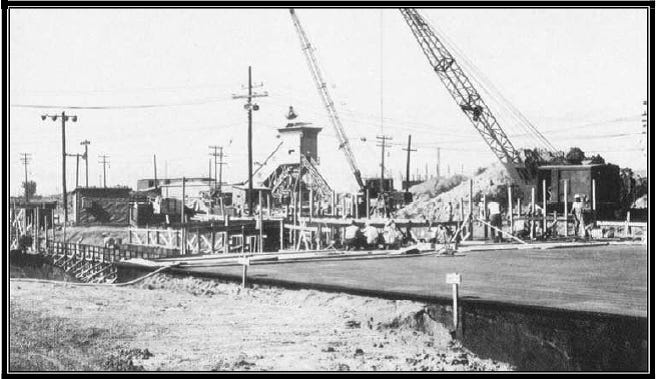
Source: US Army. Circa 1950s.
Figure 1. Construction of Subterranean Magazine.
It took another four decades for underground storage to become an operational necessity. The use of subterranean storage in the 1950s was more than likely the need to hide facilities from the enemy and gain operational advantage. Having only a few years from the end of World War II, the possibility of war was a real threat to national security. With combat operations beginning in 1950 on the Korean peninsula, it became a reality. The need to store munitions in secure locations must be safe to the surrounding communities is a desired asset. Unfortunately, the construction technology was available to build underground, but the scientific research was not available to be cost-effective and safely store ammunition.
The storage of ammunition essentially remained two folds above ground or earth-covered magazines. The first, as the name suggests, is that of structures that sit above the ground, such as a warehouse type of building. These buildings would be very susceptible to explosions. Often these types of buildings only have limited types of explosives that do not detonate unnecessarily. The preferred storage is that of the second, earth-covered magazines, concrete oval, or arched shaped facilities that are covered with ground dirt. They are often referred to as ammo bunkers. Earth covered magazine designs fall into three basic structural hardness categories; "7-Bar", "3-Bar," and "Undefined," depending upon the relative ability to resist blast loadings. With the strongest a 7-Bar ECM providing the highest level of blast resistance and allows for the least restrictive quantity separation distances. These standards have developed from the century of ammunition storage facility designs and standards. The 7-bar was once known as the standard, and undefined was once known as nonstandard. This is from the time that construction standards were unique to various areas and controlled by multiple entities. The facilities now have very definitive standards and can store more explosives depending on what the structure needs to hold and how far public space and roads are from the magazines.
There would be a certain amount of quantity distant needed if standards could not be met and fell into undefined criteria. Ammunition supply points which maintain hundreds or so magazines and even more so, Ammunition Depots which can range into the hundreds need the largest amount quantity separation distances. If communities continue to grow without proper coordination, residents can easily encroach on installation property and find themselves within an explosives arch. This can be controlled in the continental United States, where communities and the local installation have working relationships and local zoning boards to prevent building in buffer zones. The same cannot be said for overseas bases where the surrounding communities want to build and in many cases, want the return of the bases. Bases in the Pacific, such as South Korea and Okinawa, have communities and residents living right along the fence line of installations, requiring installation commanders to adjust capabilities or request senior commanders to accept risk. To find a way to prevent such problems from arising studies, assessment, and research has been conducted into alternative ammunition storage.
In 1991 the US and Republic of Korea started a five-year research and development project for Underground Ammunition Storage Technologies to reduce hazard distances that were prescribed in DOD regulation from 1992, and these studies provide updated to those regulations in 1997. Many of those updated specifications were still overly conservative for application in smaller countries like Singapore, but due to the population and high land cost, there was a need to design underground storage through updated technology. Further testing and research from 2000 were conduct in Singapore, Sweden, Switzerland, and the United States which resulted in incorporation into the manual of NATO Safety Principles for Underground Ammunition Storage. While these initiatives were for the benefit of each state, it created research that improved guidelines, standards, and regulations throughout the explosives safety community.
Facility Designs
The NATO safety principles for storage of military ammunition and explosives were published in 2008 for standards of underground storage facilities. This consists of single or series of connected chambers that should be located in sound rock, and the thickness of the rock formation surrounding an underground facility should be designed so cratering hazards can be practically excluded from the cavities. The topographical and geological aspects of the design have the most to do with the building costs and are often more costly than the aboveground storage. When the consideration of real estate, operating, maintenance, and lifetime costs are calculated for larger underground facilities, chambers measuring from 100 to 200 m in length with a volume between 5,000 and 15,000 m3, the cost may be significantly less than the aboveground facilities. Facilities are designed into a few categories, but the most common are the small, medium, and large types, each with their characteristics that provided added safety but come with additional costs. The analysis for underground storage is made to offset encroaching residential areas and increase the safety of surrounding communities. The safety of underground ammunition storage may be built-in with the design of the structure.
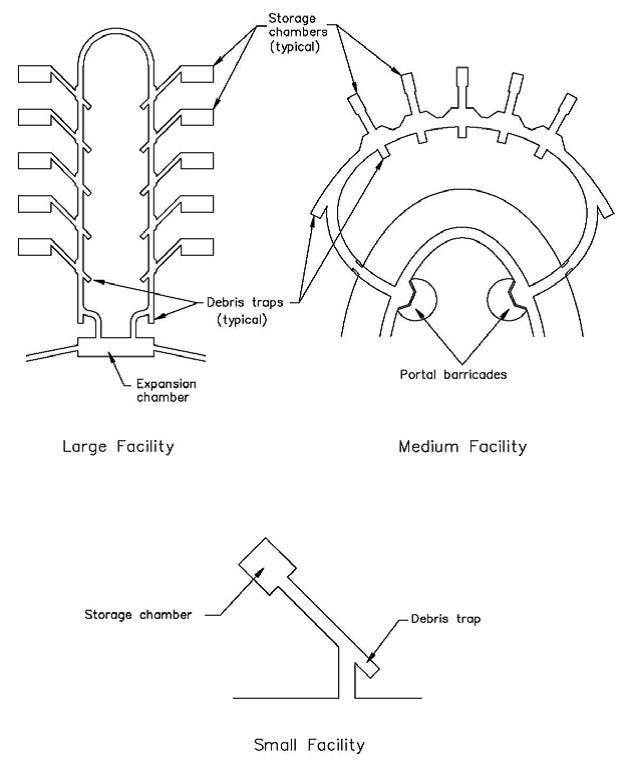
Source: DOD Manual 6055.09-M
Figure 2. Typical Underground Storage Facilities
Explosive Hazards Mitigation
For the above-ground storage distant is the mitigation used to increase the storage capacity of explosives. To some extent, barricades protect against debris but do not protect against the overpressure of explosions. Inhabited building distance for underground ammunition storage facilities may be reduced through the use of various designs such as debris traps, expansion chambers, portal barricades, and high-pressure closures. Debris traps are pockets excavated in the rock at or beyond the end of sections of tunnel that are designed to catch debris, expansion chambers are chambers that are offset in axial alignment by at least two tunnel widths, portal barricades obstruct the path of debris as it exits the tunnel, and high-pressure closures are large blocks that can obstruct or reduce the flow of blast effects and debris from an explosion from in or out of a storage chambers.
The inhabited building distance for an underground storage facility will depend on the design and construction of the facility chamber interval, adit, and cover. The interval between walls of adjacent underground storage chambers, the solid ground between the ceiling of the chamber and the surface is the cover, and the adit is passage or tunnel leading into the chamber. Each of these designs has a distance requirement along with the entire facility; if they cannot be met, the amount the facility may store might be reduced. Additionally, the depth of the facility has to be adhered to, or it is considered above-ground storage. While the underground ammunition site designs and criteria have been developed over the last twenty years, underground facilities for missile silos have been around since the Cold War.
Underground Ammunition Facilities
The most impressive example of underground ammunition storage is Singapore’s Defence Science & Technology Agency (DSTA) Ministry of Defense ten year construction of the Underground Ammunition Facility (UAF) opened in 2008. The country praises the new standards and safety designs with nearly 90 percent of reduction of land surrounding the ammunition facility for quantity distance as safety buffer; as compared to a conventional aboveground storage facility and building the facility underground saved 741 acres of land. The underground facility was built with flexibility into the layout and can be modified to meet future needs and changes; with reduced operating and maintenance costs, the projected energy cost should be less than 50 percent of similar aboveground storage facilities. This underground structure is an example of ammunition storage, which is needed for the modern-day city-state of Singapore that cannot afford to dedicate land as a buffer and prevent residential and industrial areas.
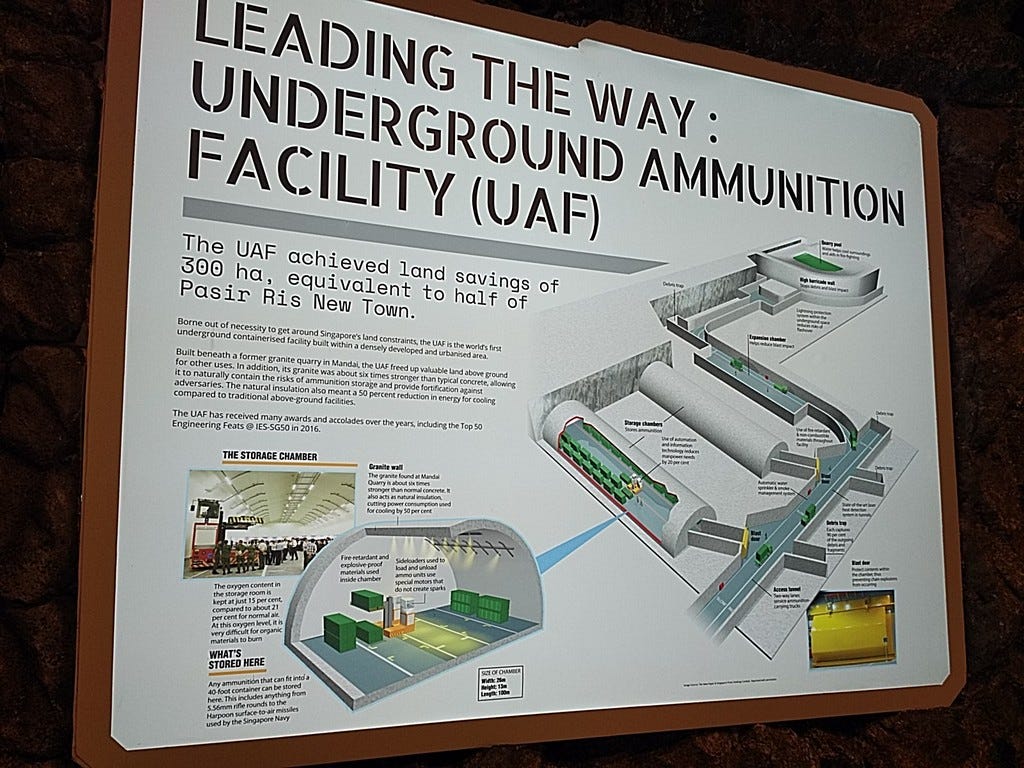
Figure 3. Underground Ammunition Facility, Singapore.
While Singapore is an ally of the United States, and they shared their technology and knowledge with the explosive community at large. The same cannot be said for other countries such as China that are not on the same terms as our allies. China began to update and expand its military underground facility program in the 1980s. Their modernization effort took a newfound resolve following the observation of U.S. and Coalition air operations during the 1991 Iraq War and Kosovo conflict. China continues to have a technologically advanced underground facility program to protect all aspects of its military forces and logistics and has thousands of underground facilities, and it continues to construct more each year.
Conclusion
Ammunition will be a key aspect to combat operations, and the production, transposition, and eventual storage is an eventual outcome that must always be dealt with. How a nation decides will vary in options on what is available and, more importantly, feasible when it comes to cost and political pressure. The option to use underground storage is most practicable to those countries with scarce land or areas that cannot have a buffer between their storage and populated areas. Countries that want protection from invasion or concealment would prefer the use of underground storage, but it would come much higher cost than to build earth covered magazines and require a larger quantity distance. The ability to reduce this buffer by 90 percent is an operational gain that might mean the difference in winning or losing in an all-out large-scale offense or defensive combat operations.