
Explosives Safety Risk-Based Approach

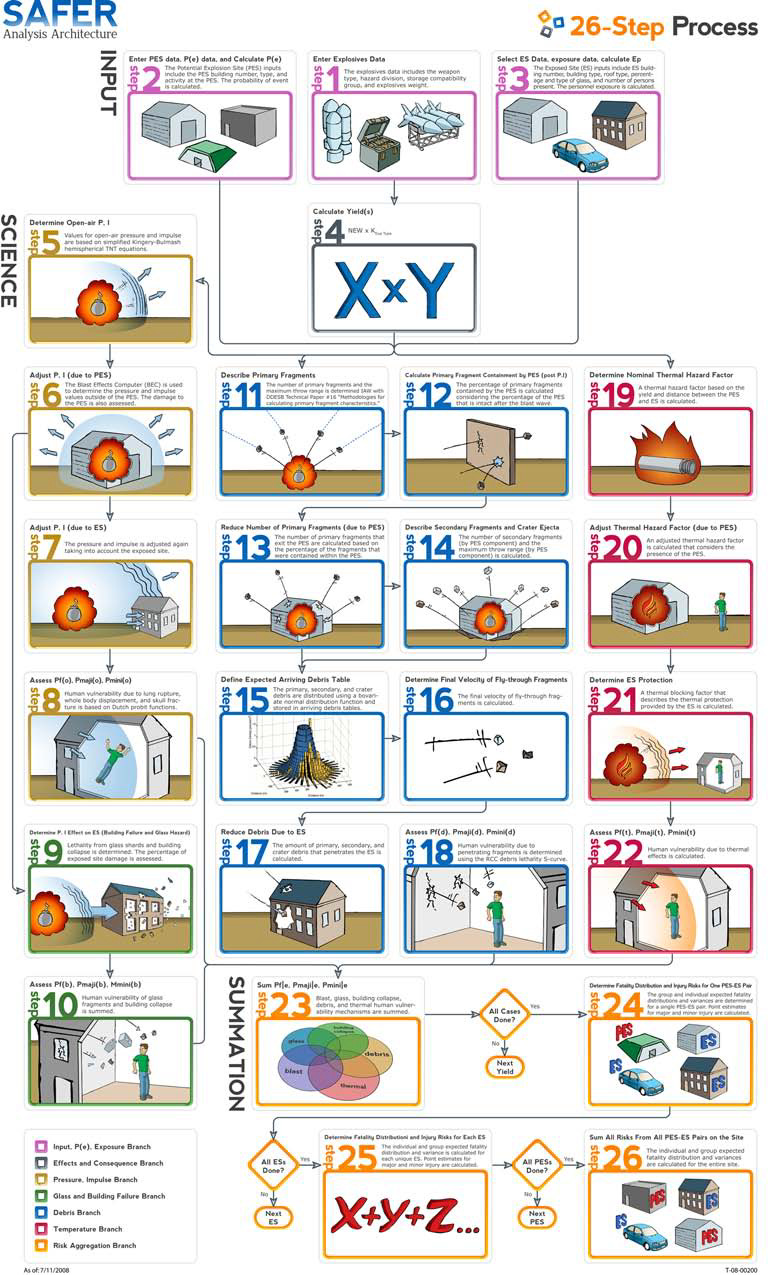
Figure 1. SAFER Version 3.1 Architecture, Technical Paper (TP) 14, Approved Methods and Algorithms for DOD Risk-Based Explosives Siting.
Quantity-Distance (QD) criteria have served as the main standard for the safe placement of facilities for over 70 years. These criteria only take into account the amount of explosives, Hazard Division (HD), and the type of facility to establish a safe separation distance.
The Department of Defense Explosives Safety Board identified the need for a risk-based method for explosives safety analysis. In 1997, they formed the Risk-Based Explosives Safety Criteria Team (RBESCT) to develop this approach, which led to the creation of the Safety Assessment for Explosives Risk tool.
The general method adopted originated in the 1600s and has been used worldwide in a variety of forms since then. In 1662, the French mathematician Blaise Pascal wrote:
“Our fear of harm ought be proportional not only to the magnitude of the harm,
but also the probability of the event.”
The basic equation is the mathematical foundation for many specific risk equations. These equations are used by SAFER and trace back to this equation:
Risk = Likelihood x Consequences x Exposure
DESR 6055.09 provides guidance and minimum requirements for quantitative risk-based siting. It provides the basis for quantifying risks from a PES to personnel at each exposed site (ES) (individual risk, probability of fatality (Pf )) and at all exposed sites (group risk, expected fatalities (Ef)) by performing a quantitative risk assessment when the QD criteria of this manual cannot be met. Procedures are provided for preparing, submitting, and periodically reviewing risk-based sites.
Pf is a function of the probability of an explosives event, the Pf given an event and exposure, and the exposure of one person.
Ef is a function of the probability of an explosives event, the Pf given an event and exposure, and the exposure of all persons within the risk-based evaluation distance.
Risk Assessment Tools
A Quantitative Risk Assessment (QRA) tool for risk management of explosives storage and operating scenarios, and the associated exposures (related or unrelated personnel and facilities) to those scenarios, can facilitate a comparison of risks before acceptance of the risks associated with the selected scenarios.
The DDESB provides the military departments with the flexibility to assess risks using a variety of Explosive Safety and Munitions Risk Management (ESMRM) tools. Selecting the right tool depends on the complexity of the task:
Explosives Safety Siting (ESS): The DDESB-approved automated tool for standard site planning.
Safety Assessment for Explosives Risk (SAFER): performs quantitative risk analysis to determine risk to people from a potential explosion site (PES) by conducting a sequential calculation of the probability of event, explosives effects, and personnel exposure.
Automated Safety Assessment Protocol–Explosives (ASAP-X): A versatile Excel-based protocol (available in US, NATO, and DTRA versions) for assessing ESQD consequences.
Field Assessment Spreadsheet Tool for Operational Munitions Risk Management in Explosive Safety Site Planning (FAST-Site): Designed for field assessments and operational risk management.
Nomographs: Graphical representations used for quick visual assessments of safety deviations. An example can be found here. Follow Link
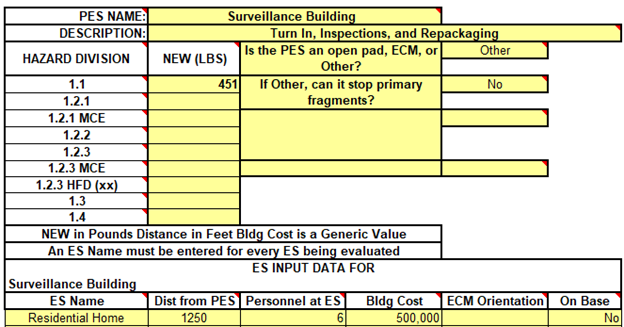
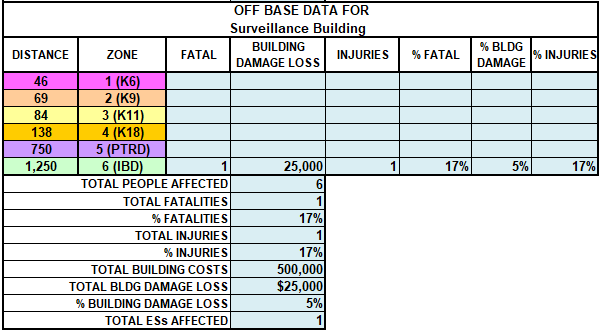
ASAP-X Example
Variables:
1.1 NEW 451 lbs.
Distance 1,250
Other Building (PES)
Residential Home (ES)
Personnel 6
Input
Output
References
ASAP-X, https://www.denix.osd.mil/ddes/explosive-safety-tools/
DESR 6055.09, Edition 1, Change #2 (Published November 25, 2025), https://www.denix.osd.mil/ddes/denix-files/sites/32/2022/08/DESR-6055.09-Edition1-Change-2-251208.pdf
TP-14, Approved Methods and Algorithms for Dod Risk-Based Explosives Siting, https://apps.dtic.mil/sti/tr/pdf/ADA507495.pdf
TP-23 Assessing Explosives Safety Risks, Deviations, and Consequences, https://www.denix.osd.mil/ddes/ddesb-technical-papers/
Updated Blast Effects and Consequences Models in DDESB TP-14 Revision 5,
https://ndia.dtic.mil/wp-content/uploads/2018/intexpsafety/Conway2.pdf